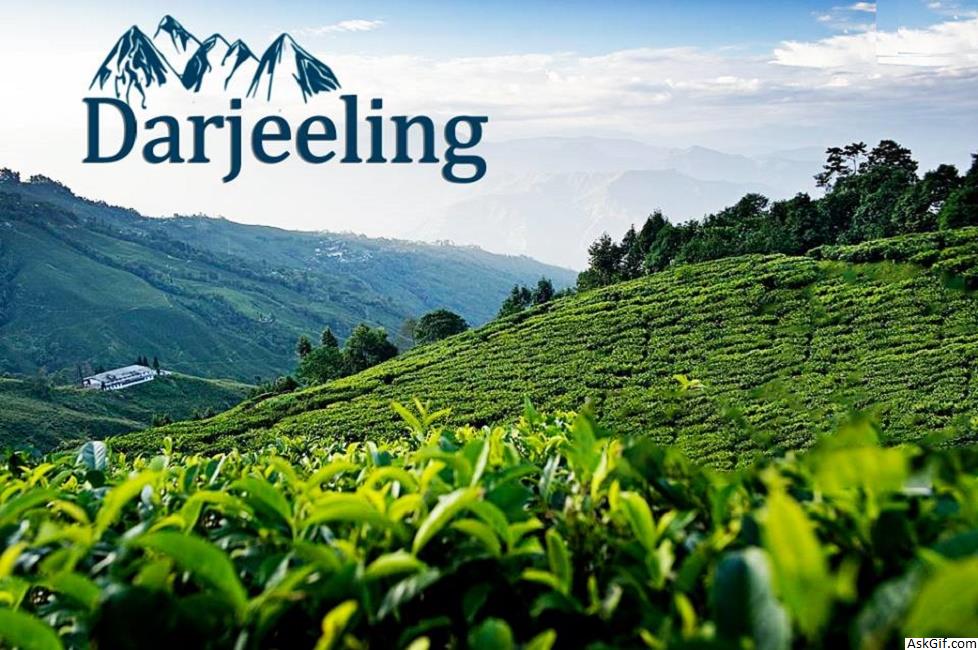
Darjeeling is a city and a municipality in the Indian state of West Bengal. It is located in the Lesser Himalayas at an elevation of 6,700 ft (2,042.2 m). It is noted for its tea industry, its views of Kangchenjunga, the world's third-highest mountain, and the Darjeeling Himalayan Railway, a UNESCO World Heritage Site. Darjeeling is the headquarters of the Darjeeling district which has a partially autonomous status within the state of West Bengal. It is also a popular tourist destination in India.
The recorded history of the town starts from the early 19th century when the colonial administration under the British Raj set up a sanatorium and a military depot in the region. Subsequently, extensive tea plantations were established in the region and tea growers developed hybrids of black tea and created new fermentation techniques. The resultant distinctive Darjeeling tea is internationally recognised and ranks among the most popular black teas in the world. The Darjeeling Himalayan Railway connects the town with the plains and has some of the few steam locomotives still in service in India.
Darjeeling has several British-style private schools, which attract pupils from all over India and a few neighbouring countries. The varied culture of the town reflects its diverse demographic milieu comprising Lepcha, Khampa, Gorkha, Newar, Sherpa, Bhutia, Bengali and other mainland Indian ethno-linguistic groups. Darjeeling, alongside its neighbouring town of Kalimpong, was the centre of the Gorkhaland social movement in the 1980s and summer 2017.
Tourism
Tourist inflow into Darjeeling had been affected by the political instability in the region, and agitations in the 1980s and 2000s hit the tourism industry hard. However, since 2012, Darjeeling has once again witnessed a steady inflow of both domestic and international tourists. Presently, around 50,000 foreign and 500,000 domestic tourists visit Darjeeling each year, and its repute as the "Queen of the Hills" remains unaltered. According to an India Today survey published on 23 December 2015, Darjeeling is the third most Googled travel destination among all the tourist destinations in India. Even though there are political instabilities in Darjeeling, its tourism rate is increasing year by year. Many visit this place for food specialities like momos, steamed stick rice, and other steamed foods famous in this region, as well as to see the natural beauty of the area.
Transport
Main article: Transport in Darjeeling
A train, hauled by a steam locomotive, running beside a road between two rows of buildings with a few people walking on the road.
The narrow gauge train often crisscrosses the street
Darjeeling "Toy Train"
Darjeeling can be reached by the 88 km (55 mi) long Darjeeling Himalayan Railway from New Jalpaiguri, or by National Highway 55, from Siliguri, 77 km (48 mi) away. The Darjeeling Himalayan Railway is a 600 mm (2 ft) narrow-gauge railway that was declared a World Heritage Site by UNESCO in 1999 for being "an outstanding example of the influence of an innovative transportation system on the social and economic development of a multi-cultural region, which was to serve as a model for similar developments in many parts of the world", becoming only the second railway in the world to have this honour. Bus services and hired vehicles connect Darjeeling with Siliguri and Darjeeling has road connections with Bagdogra, Gangtok and Kathmandu and the neighbouring towns of Kurseong and Kalimpong. However, road and railway communications often get disrupted in the monsoons because of landslides. The nearest airport is Bagdogra Airport, located 90 km (56 mi) from Darjeeling. Within the town, people usually traverse by walking. Residents also use two-wheelers and hired taxis for travelling short distances. The Darjeeling Ropeway, functional since 1968, was closed in 2003 after an accident killed four tourists. It reopened in February 2012.
Demographics
Main article: Demographics of Darjeeling
A man and a woman praying at a small white shrine dedicated to Lord Ganesh. Several colourful flags on buntings are strung across poles in front of the shrine.
Colourful Buddhist prayer flags around Mahakal Temple at Observatory Hill, Darjeeling.
St. Andrew's Church, Darjeeling. Built- 1843, Rebuilt- 1873
According to provisional results of 2011 census of India, Darjeeling urban agglomeration has a population of 132,016, out of which 65,839 were males and 66,177 were females. The sex ratio is 1,005 females per 1,000 males. The 0–6 years population is 7,382. Effective literacy rate for the population older than 6 years is 93.17 per cent.
According to the 2001 census, the Darjeeling urban agglomeration, with an area of 12.77 km2 (4.93 sq mi), had a population of 109,163, while the municipal area had a population of 107,530. The population density of the municipal area was 10,173 per km2. The sex ratio was 1,017 females per 1,000 males, which was higher than the national average of 933 females per 1000 males. Gorkhas, speaking Nepali as native language, form the majority which includes indigenous ethnic groups such as the Bhutia, Chhetri, Gurung, Lepcha, Limbu, Magar, Newars, Rajbanshi, Rai, Sherpa, Tamang, Yolmo, along with several other denominations under the Indo-Aryan Khas and the Mongoloid Kirats. Other communities that inhabit Darjeeling include the Anglo-Indians, Bengalis, Biharis, Chinese, Marwaris and Tibetans. The prevailing languages are Nepali, Hindi, Bengali and English. Bengali is prevalent in the plains while Tibetan is used by the refugees and some tribal people. Dzongkha is spoken by the Bhutias and the Tibetans.
Darjeeling has seen a significant growth in its population, its decadal growth rate being 47% between 1991 and 2001. The colonial town was designed for a population of only 10,000, and subsequent growth has created extensive infrastructural and environmental problems. The district's forests and other natural wealth have been adversely affected by an ever-growing population. The official languages of Darjeeling are Bengali and Nepali.
Culture
Main article: Culture of Darjeeling
Peace Pagoda
A two-storeyed building to the right of a four-storeyed building. A basketball court in the foreground and a couple of vehicles parked on either side. Foggy atmosphere, with trees in the background.
Tibetan Refugee Self Help Centre
The culture of Darjeeling is diverse and includes a variety of indigenous practices and festivals as mentioned above. Many of the Nepali Hindus, as well as the various Buddhist and other ethnic groups such as the Lepchas, Bhutias, Kiranti Limbus, Tibetans, Yolmos, Gurungs and Tamangs, have their own distinct languages and cultures and yet share a largely harmonious co-existence.
Colonial architecture characterizes many buildings in Darjeeling, exemplified by several mock Tudor residences, Gothic churches, the Raj Bhawan, Planters' Club and various educational institutions. Buddhist monasteries showcase the pagoda style architecture. Darjeeling is regarded as a centre of music and a niche for musicians and music admirers. Singing and playing musical instruments are common pastimes among the resident population, who take pride in the traditions and role of music in cultural life. Darjeeling also has a Peace Pagoda built in 1992 by the Japanese Buddhist organisation Nipponzan Myohoji.
Cuisine
Due to the varied mix of cultures in Darjeeling, the local and ethnic food of Darjeeling is also quite varied. Rice, noodles and potatoes seem to make up the dominant part of the cuisine partly due to the cold climate. The most popular local snack food are Momos, which are steamed flour dumplings with meat or vegetables fillings served piping hot with a side of clear soup and hot homemade tomato sauce. Locals love Alu Dom (Spicy steamed potato curry) and various versions of it are served. For example, they add Wai Wai Mimi instant noodles over a bowl of Alu Dom and call it Alu Mimi.
Another popular food is Thukpa which is of Tibetan origins. Thukpa is homemade noodle soup with meat, eggs and/or vegetables. Kinema, Chhurpi, Shaphalay, (Tibetan bread stuffed with meat). Fermented foods and beverages are consumed by a large percentage of the population. Fermented foods include preparations of soybean, bamboo shoots, milk and Sel roti, which is made from rice. Tea (esp. the butter tea) is the most popular delicacy, Alcoholic beverages include Tongba, Jnaard and Chhaang, variations of a local beer made from fermenting finger millet.
Education
There are 52 primary schools, 67 high schools and 5 colleges in the town. Darjeeling's schools are run either by the state government or by private or religious organisations. Schools mainly use English and Nepali as their media of instruction, although there is the option to learn the official language Hindi and the official state language Bengali. The schools are either affiliated with the ICSE, the CBSE, or the West Bengal Board of Secondary Education.
Having been a summer retreat for the British in India, Darjeeling became the place of choice for the establishment of public schools on the model of Eton, Harrow and Rugby, allowing the children of British officials to obtain an exclusive education. Institutions such as Mount Hermon School, St. Robert's H.S. School, St. Paul's School, St. Joseph's School - North Point, Loreto Convent are renowned as centres of educational excellence. Darjeeling has five colleges—St. Joseph's College, Southfield College (earlier known as Loreto College), Darjeeling Government College, Ghoom-Jorebunglow Degree College and Sri Ramakrishna B.T. College—all affiliated to the University of North Bengal in Siliguri.
source: https://en.wikipedia.org/wiki/Darjeeling