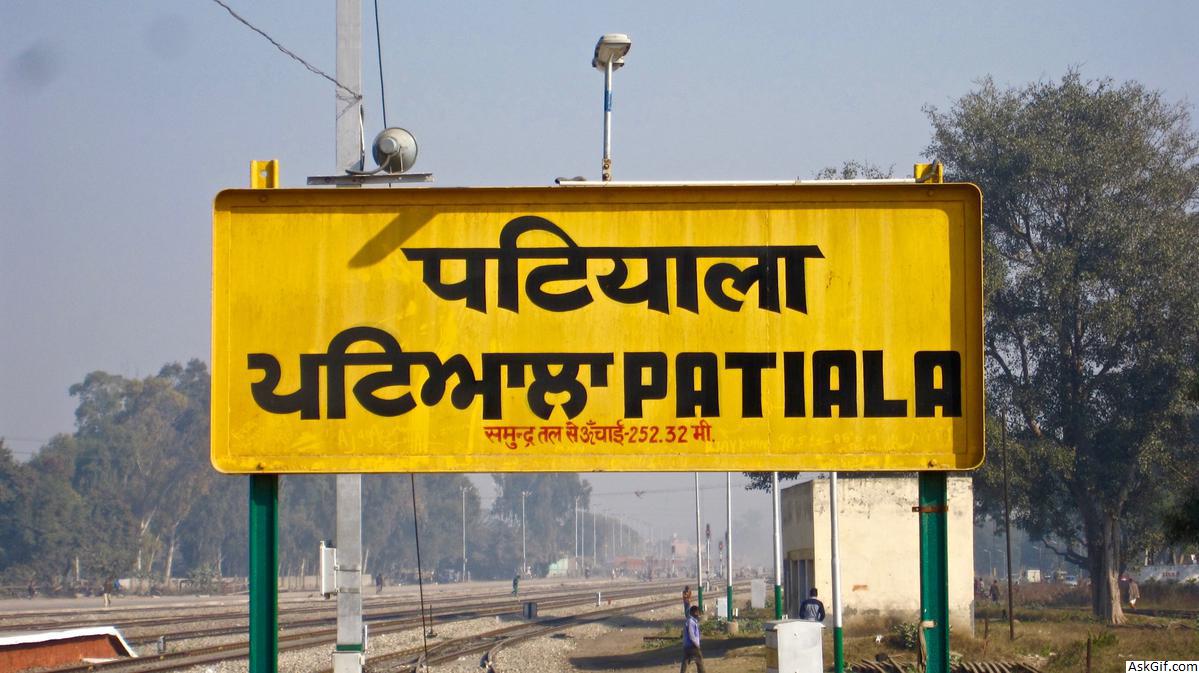
Patiala district is one of the twenty two districts in the state of Punjab in north-west India.
Districts of Punjab along with their headquarters
Patiala District lies between 29 49’ and 30 47’ north latitude, 75 58’ and 76 54' east longitude, in the southeast part of the state. It is surrounded by Fatehgarh Sahib, Rupnagar and Mohali to the north, Fatehgarh Sahib and Sangrur districts to the west, Ambala, Panchkula, Haryana to the north east and Kurukshetra districts of neighbouring Haryana state to the east, and Kaithal district of Haryana to the south west.
Baba Ala Singh (1691–1765), a Sikh chieftain from village Rampura Phul in Bathinda District of Punjab, with his army of young brave men migrated to Barnala where Baba Ala Singh in 1763 set up his new state. Later Baba Ala Singh moved to a small village of Lehal where he built a new city on the village, naming it as Patiala. He laid the foundations of a steady and stable state known as Phulkian Dynasty south of Sirhind. In and around Patiala District he founded many villages within his territory, and reconstructed many historical Gurdwaras relating to Sikh religion.
It was since Baba Ala Singh's time that Patiala District came into being as before the area was under the Sirhind Government. Baba Ala Singh made Sirhind, Tohana, Mansa, Bathinda, Sangrur and Barnala, Fatehabad District part of Patiala State.
In 1809 Patiala State came under British protection during the reign of Maharaja Sahib Singh (1773–1813) of Phulkian Dynasty, as he feared that Maharaja Ranjit Singh of Lahore would cross the Sutlej river and take the district and state so the Patiala rulers got the British to protect them from further invasion from 1809-1947 Patiala remained under British Protection. In 1948 Patiala Princely State was abolished by the Indian government.
Patiala District was further divided into Fatehgarh Sahib District on 13 April 1992 Vaisakhi.
Patiala district population mainly follows Sikhism with a lesser number of Hindus and smaller numbers of Christians and Muslims.
Patiala having a population of 1,892,282 is the 4th most populated district of the Punjab after Ludhiana, Amritsar and Jalandhar as per the 2011 census.
Divisions
The district is divided into three sub-divisions: Patiala, Rajpura and Nabha, which are further divided into five tehsils: Patiala, Rajpura, Nabha, Samana, Pattran. It also comprises eight blocks, Patiala, Rajpura, Nabha and Samana.
There are nine Punjab Vidhan Sabha constituencies located in this district: Patiala Urban, Patiala Rural, Rajpura, Nabha, Samana, Ghanaur, Shutrana, Sanaur, and Patran. All of these are part of Patiala Lok Sabha constituency.
Industry
Patiala is fast emerging as an important industrial growth centre on the industrial map of the state. Besides traditional goods, high quality and sophisticated items are now produced including small cutting tools, power cables, Vanaspati ghee, bicycles and agriculture implements including harvester combines and threshers, milk products, and pesticides. The industrial units are scattered all over the district mainly at Rajpura, Patiala, Samana and Nabha. There are large and medium industrial units located at Rajpura producing Vanaspati ghee, power cables, bicycles and bicycle components and at Dera bassi producing spun-yarn and alcohol. Among the small scale industry in the district are those producing agriculture implements, rice shellers, cutting tools, electrical goods and bakeries. There are industrial focal points at Patiala, Rajpura, Nabha and Dera bassi and two industrial estates at Rajpura, Patiala.
Education
Mohindra College, Patiala
Since Indian independence in 1947, Patiala has emerged as a major education centre in the state of Punjab. The city houses the Thapar Institute Of Engineering And Technology, LM Thapar School OF Management,Punjabi University, Rajiv Gandhi National University of Law, General Shivdev Singh Diwan Gurbachan Singh Khalsa College, Mohindra College, Aryans College of Law, Multani Mal Modi College, Rajindra Hospital, Government Medical College, Patiala, Prof. Gursewak Singh Government College of Physical Education, Government College for Girls, and Govt. Bikram College of Commerce, one of the premier commerce colleges in northern India.
Netaji Subhash National Institute of Sports, Patiala is a sports hub of north India. Rajiv Gandhi National University of Law, Patiala was the first national law school of the north region established under Punjab Government Act of 2006.
Patiala city has many playgrounds, including the Raja Bhalindra Sports Complex, more commonly known as Polo Ground on Lower Mall Road, which houses an indoor stadium. Other sports facilities include Yadavindra Sports Stadium for athletics, Rink Hall for roller skating, Dhruv Pandov Cricket Stadium for cricket and National Institute of Sports, Patiala.
Culture and traditions
Phulkari from Patiala
Patiala's sway over the Malwa area extended beyond merely political influence. Patiala was equally the set of religious and cultural life. Educationally, Patiala was at the forefront. Patiala was the first town in this part of the country to have a degree in college – the Mohindra College – in 1870.
Patiala has seen the evolution of a distinct style of architecture. Borrowing from the Rajput style, its beauty and elegance are moulded according to the local traditions.
Phul Cinema on the Mall facing the Fountain Chowk is built in Art Deco style
With the active patronage of the Maharajas of Patiala, a well-established style of Hindustani music called the "Patiala Gharana" came into existence and has held its own up to the present times. This school of music has had a number of famous musicians, many of whom came to Patiala after the disintegration of the Mughal Court at Delhi in the 18th century. At the turn of the century, Ustad Ali Bux was the most renowned exponent of this Gharana. Later, his sons Ustad Akhtar Hussain Khan and Ustad Bade Ghulam Ali Khan achieved worldwide fame and brought glory to the Patiala Gharana.
After the partition of British India, Muslims were forced to flee the city en masse to Pakistan, while many Hindu and Sikh refugees migrated from Pakistan and settled on the Muslim properties in Patiala. The then Maharaja of Patiala, His Highness Yadavindra Singh, Rajpramukh of PEPSU with his wife Her Highness Maharani Mohinder Kaur organised a large number of camps and worked tirelessly for the people.
Transport
Patiala has one of the highest number of vehicles per capita in India.
It is connected to cities like Ambala, Kaithal, Chandigarh, Amritsar, Delhi etc. by road. Patiala is well connected to cities like Ludhiana, Jalandhar and Amritsar, on NH 1 via State Highway no. 8 till Sirhind, which is on NH 1. Patiala is well connected to Delhi by road as well as by rail. NH 64 (Zirakpur – Patiala – Sangrur – Bhatinda) connects Patiala with Rajpura (on NH 1 and very well connected to Delhi) and Zirakpur(suburb of Chandigarh). Patiala has a railway station under Ambala railway division and Patiala Airport, which is not operational. The nearest domestic airport is Chandigarh Airport, which is approximately 62 km from the city. Patiala is located very close to Nabha city. The distance between Patiala and Nabha is approximately 27km and it takes approximately half an hour by road to reach Nabha.
Patiala is connected by road to all the major towns.
Distance between the major towns and Patiala:
Kaithal - 68 km
Ambala - 51 km
Amritsar – 235 km
Bathinda - 156 km
Chandigarh – 67 km
Cheeka - 41km
Chennai – 2390 km
Delhi – 233 km
Indore – 1082 km
Jaipur – 454 km
Jalandhar – 155 km
Jammu – 301 km
Kolkata – 1637 km
Lucknow – 669 km
Ludhiana – 93 km
Mumbai – 1627 km
Pundri - 78 km
Rajpura - 32 km
Shimla – 173 km
Zirakpur - 58 km
Entertainment
The city has the following single screen cinema halls: Phul, Malwa, Capital. SRS Omaxe mall is a local mall and multiplex.
Notable people
Name Occupation
Mahendra Singh of Patiala Maharaja of Princely State Patiala
Maharaja Rajinder Singh Maharaja of Princely State Patiala
Bhupinder Singh Grandfather of Captain Amarinder Singh and Maharaja of Princely State Patiala
Mohinder Kaur Rajmata of Patiala and Mother of Captain Amarinder Singh
Captain Amarinder Singh 29th Chief Minister of Punjab
Preneet Kaur MP & Minister of State for External Affairs (Central Govt. under PM Manmohan Singh)
Bibi Amtus Salam Social worker
Pawan Kumar Bansal Four times MP, Union Minister of India (twice)
Surjit Singh Rakhra Member of Legislative Assembly
Dalip Kaur Tiwana Punjabi writer
Damandeep Singh Baggan Dub-over voice actor
Roopinder Singh Assistant Editor of The Tribune; writer
Harpal Tiwana Actor, writer and director
Abhinav Bindra First Indian to win an individual gold medal at the Olympics
Samiksha Actor
Smeep Kang Actor, writer and director
Raninder Singh President of National Rifle Association of India (NRAI)
Bhupinder Singh (musician) Singer and musician
Balraj Pandit Theatre director, playwright
Jimmy Shergill Actor
Fawad Khan Actor (His father migrated from Patiala)
Gulzar Inder Chahal Actor and cricketer
Gavie Chahal Actor
Rakesh Sharma First Indian astronaut
Satwinder Bitti Punjabi singer
Harbhajan Mann Punjabi singer and actor
Mika Singh Punjabi singer and actor
Dilshad Khan Husband of Parveen Sultana; member of Patiala Gharana; singer
Fateh Ali Khan Member of Patiala Gharana; singer
Hamid Ali Khan Member of Patiala Gharana; singer
Jagdish Prasad Member of Patiala Gharana; singer
Johar Ali Khan Member of Patiala Gharana; singer
Kaushiki Chakraborty Daughter of Ajoy Chakraborty; member of Patiala Gharana; singer
Lakshmi Shankar Member of Patiala Gharana; singer
Munawar Ali Khan Son of Bade Ghulam Ali Khan; member of Patiala Gharana; singer
Nirmala Devi Member of Patiala Gharana; singer
Parveen Sultana Member of Patiala Gharana; singer
Raza Ali Khan Grandson of Bade Ghulam Ali Khan; member of Patiala Gharana; singer
Sanjukta Ghosh Member of Patiala Gharana; singer
Shafqat Amanat Ali Member of Patiala Gharana; singer
Mohammad Hussain Sarahang from Afghanistan Member of Patiala Gharana; singer
Daler Mehndi Punjabi singer
Pammi Bai Punjabi singer
Malkit Singh Punjabi singer
Vinaypal Buttar Punjabi singer
Navjot Singh Sidhu Former cricketer, actor, commentator and politician
Mohinder Amarnath Cricketer
Sandeep Sharma Cricketer
Sarabjit Ladda Cricketer
Anmolpreet Singh Cricketer
Prabhsimran Singh Cricketer
Ish Sodhi Cricketer
Ravi Inder Singh Cricketer
Jiwanjot Singh Cricketer
Deepak Thakur Hockey Player
Heena Sidhu Shooter
Kamal Khan (singer) Singer
Navneet Kaur Dhillon Femina Miss India 2013
Suburbs of Patiala
Nabha (Municipal Council) 25 km
Rajpura (Municipal Council) 27 km
Samana (Municipal Council) 27 km
Tourist Places
Bahadargarh Qila Patiala
Qila Bahadurgarh
The ninth Guru Tegh Bahadur stayed at Saifabad during his travels. Originally known as Saifabad.
Kali Mata Mandir Patiala
Kali Temple
Maharaja Bhupinder Singh was inspired to build this temple and bring the 6-ft statue of Kali from Bengal to Patiala.
ਗੁਰੂਦੁਆਰਾ ਦੁਖਨਿਵਾਰਨ ਸਾਹਿਬ, ਪਟਿਆਲਾ
Gurudwara Dukhniwaran Sahib
Category Religious
The villagers of Lehal donated land for the modest Gurudwara built on this elevated site.
garden
Baradari Gardens
The Baradari gardens surround the Baradari palace located in the north of old Patiala city, just outside Sheranwala Gate.
Bir Moti Bagh Patiala
Bir Moti Bagh
A 1,600-acre forest on the outskirts of Patiala, The Bir was originally the hunting preserve of the Maharaja.
heritage
Sheesh Mahal
The Sheesh Mahal was built behind the main Moti Bagh Palace to serve as a pleasure complex.
NSNIS Patiala
Moti Bagh Palace
Started during the reign of Maharaja Narinder Singh, it was completed under Maharaja Bhupinder Singh in the early 20th century.
source: https://en.wikipedia.org/wiki/Patiala