Washim is a city and a municipal council in Washim district in the Indian state of Maharashtra. Washim is the district headquarters of Washim district.
Washim is a district in Maharashtra, India. The headquarters is at Washim. The area of the district is 5,150 km².
Places of interest
The antiquity of the town has given rise to a number of objects and places of interest in the town. The chief among them are Padmatirtha, Balaji temple, Rama temple, Madhyameshvara temple, Godeshvara temple, two Jain temples and Narayana Maharaja temple. The Vatsagulmamahatmya mentions that the town contains 108 holy tanks and tirthas. A few of them can still be identified in the town.
Padmatirth Washim is known to have had 108 tirthas, holy places or sacred springs, associated with different gods and rishis. The Padmatirtha is one of the chief tirthas created by Vishnu. The reference to this tirtha has already occurred in the story connected with the origin of the name of the town, it is situated in the northern quarters of the town. The sides are built up in cut stones. Now the tirtha comprises two kundas one to the north and the other to the south. Recently one Shri Rama-narayan Toshnival has constructed a small but artistic temple dedicated to Mahadeva in the centre of the kund used formerly by those who entered the tirtha for swimming as their resting place it is a cement concrete construction. An east-west bridge has been put across the tirtha to facilitate the entrance to the temple. It is said that the colour of the shalunka placed in the temple changes thrice in a day i. e., once in the morning, then in the afternoon and last in the evening. According to the Settlement Report of 1871, the tank used to supply all the drinking water required by the town but it has since lost its purity and taste. The people use the tirtha for the immersion of bones and ashes of the dead whose last rites are performed on its bank. the tirtha is also used for swimming purposes.
Balaji Mandir The temple of Balaji is a considerably old temple in the town and was constructed by Bhavani Kalu who rose to be the divan of Sabaji Bhosle and Janoji Bhosle. He constructed the temple in 1779 AD when he was the Subhedar at the thana of Karanja. The shrine is much revered. The images in the temple of Vyankateshvar Balaji are said to have been buried during Aurangzeb's reign to save them from destruction. All trace of them was lost, but in about 1760 a horseman happened casually to turn up a little earth with his stick and perceived a finger of an image. Images of Brahma, Vishnu, Mahadeva, Parvali, Devi, Ganapati, and Naga were taken out. At that time bhavani Kalu, who had been patvari of the village Khadi Dhanini in Mangrul tahsil but had become the Divan (or according to some accounts, a general) of the Bhosle Rajas, was at Bashini. He set up the present temple, a fine building standing in a large paved quadrangle, with a well-built verandah for pilgrims to stay, a bhandara for Brahmans to take food, and various offices. The work look 12 years but was finished, according to an inscription on a pillar in front, in 1700 Shaka, AD 1776. The Dev Talay or Balaji Talav, a large square tank with stone built sides, strongly and handsomely finished, and with a Jalakridasthana, resting-place for swimmers, in the middle, was made at the same time. The chief image is of black stone and sparkles with ornaments; a fine view of the town is to be obtaineu from the top of the temple gateway, though the staircase is rather abrupt. A dome plated with gold has recently been constructed over the inner chamber of the temple. According to the old Gazetteer 'large jagirs and inams were given for the support of the temple, the present revenue being Rs. 11,000 from those sources and Rs. 3,000 from kangi offerings. A big fair is held in honour of Balaji. in Ashvina (September–October). About 12,000 to 15,000 people assemble at the time of the fair.
Balaji Talav The Deo talav also known as Balaji talav, a large square tank with stone built sides, strongly and handsomely finished and with a jalakridasthana, resting place for swimmers in the middle, was laid out at the time of the construction of Balaji mandir in 1770 A D. The temple is flanked on one side by the temple of Vyankateshvar Balaji and on the other by that of Ramchandra. The tree plantations by tile side of the tank have now thoroughly disappeared. During the Ganapati festival, the immersion of the idols takes place in this tank and as a result this tank is getting silted gradually. However, the tank still stands in good condition.
Rama Mandir On the other side of the Deo talav is a temple dedicated to Ramchandra, a large enclosed building but not, by any means as fine as the temple of Baiaji. it contains images of Lakshmana, Sita, Maruti and Rariha Krishna besides that of Ramchandra. It is said to have been built by one Bhagvandas Maharaj Bairagi about 250 years ago. In front of the temple, has recently been constructed a two-storeyed dharmashala. It is used by the bairagis who visit the temple. Marriage and such other religious functions also take place in this dharmashala. Ramanavami is celebrated at this temple with great pomp.
Daridrya Harana Tirtha The Daridrya-harana Tirtha is said to have been created by Shri Dattatreya. Well built as the tank seems to have been formerly, the steps on only one side are noticeable now. By the side of the tank is a large banyan tree. One anecdote about the tirtha says that king Dashratha of Ayodhya, the father of Rama, killed Shravana by mistake by sitting over this tree.
Madhyameshvar Mandir was constructed about 5 to 7 years ago. After entering a big audience hall there is an inner chamber where is placed a shalunka of Shiva. At the time of the construction of the temple some images and inscriptions were excavated at the site. The temple is said to have been constructed at a place from where according to the belief of astronomers passes the equator and hence the temple is known as the Madhyameshvara temple.
Narayana Maharaja Temple has recently been constructed over the satnadhi of Narayana Maharaja who stayed at Washim. The image of Narayana Maharaj has been placed over the satnadhi. One has to go a few steps below the ground level to reach this shrine. From there another staircase leads to the altar where is placed the image of Shri Dattatreya. The whole construction is of white marble. The temple owns some adjacent land. The audience hall is under construction. Every year a small fair attended by the local populace is held on Datta jayanti.
Gondeshvara Temple To the west of the town is the temple of Gondeshvara, much in a dilapidated condition. In the temple, are three images viz., those of Vishnu, his sister and Lakshmi. By the side of the temple is ample garden land making the whole panorama of the temple extremely beautiful.
Shringi Rishi To the South East direction, on the way to Pusad, there is a small town called Ansing which is corrupt name of Ekshring Shringi Rishi. He was the one who performed Putrakameshti yajna or the holy pyre for Dasharatha and his wives Kaushalya, Kaikeyi and Sumitra. Then they begot Ram, [[Lakshman], Bharat[disambiguation needed] and Shatrughna. His temple is located on the far east of town.
Transport
Road
Washim is connected by State Highways to all the important cities of Maharashtra. Important Roads include Washim-Mangrul Pir-Karanja-Ner-Yavatmal, Washim-Karanja-Amravati-Nagpur, Washim-Malegaon-Akola, Washim-Risod-Lonar-Sindhkhed Raja-Jalna-Aurangabad-Ahmadnagar-Pune-Mumbai, Washim-Pankanergaon-Hingoli-Nanded and Washim-Ansing-Pusad.
Rail
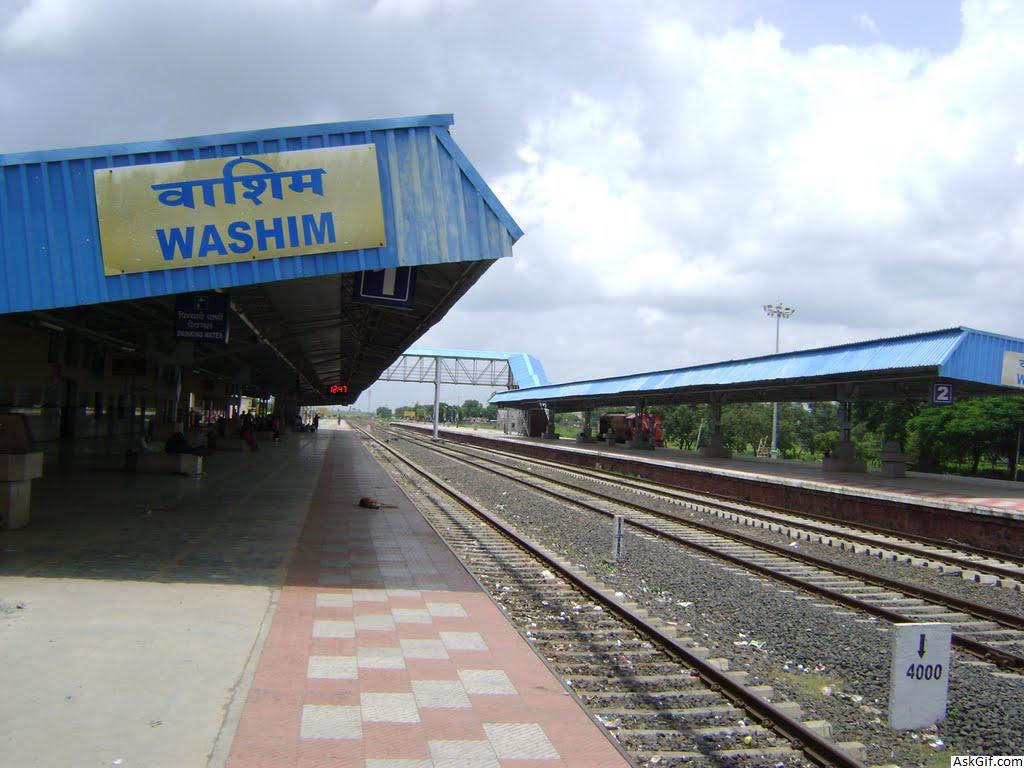
Washim is a railway station on Purna-Khandwa section of South Central Railway (SCR). It was in Hyderabad division of SCR and now is in Nanded division after bifurcation of Hyderabad division. Washim was connected to the broad gauge railway network in 2008 when tracks were extended from Purna to Akola.
17639/17640 Kachiguda Akola express can be accessed by the passengers arriving from Nagpur or Mumbai route while Hyderabad and Nanded can be accessed from the south. Weekly, Bi-weekly, Special, Daily, Intercity trains connecting to major stations like Delhi, Mumbai, Pune, Tirupati, Agra, Mathura, Amritsar, Chandigarh, Ambala, Ludhiana, Shri Ganganagar, Jaipur, Ajmer, Kota, Hyderabad, Nangaldam (Himachal Pradesh) Aurangabad, Nagpur, Indore, Yeshwantpur (Bangalore), Nashik, Nanded, Amravati, Bhopal, Khandwa, etc. from Washim. Washim has 3 platforms. After New Construction Of Railway Station, All railway department authority try to keep it neat and clean making it an ideal railway station.
source: https://en.wikipedia.org/wiki/Washim