Bhopal is the capital city of the Indian state of Madhya Pradesh and the administrative headquarters of both Bhopal district and Bhopal division. Bhopal is known as the City of Lakes for its various natural and artificial lakes and is also one of the greenest cities in India. It is the 16th largest city in India and 131st in the world.
Founded in 1707, the city was the capital of the former Bhopal State, a princely state of the British ruled by the Nawabs of Bhopal. Numerous heritage structures from this period include the Taj-ul-Masajid and Taj Mahal palace. In 1984, the city was struck by the Bhopal disaster, one of the worst industrial disasters in history.
A Y-class city, Bhopal houses various educational and research institutions and installations of national importance, including ISRO's Master Control Facility, BHEL, and AMPRI. Bhopal is home to the largest number of institutes of National Importance in India, namely IISER, MANIT, SPA, AIIMS, NLIU and IIIT (currently functioning from a temporary campus inside MANIT) .
The city attracted international attention in December 1984 after the Bhopal disaster, when a Union Carbide India Limited (UCIL) pesticide manufacturing plant (now owned by Dow Chemical Company) leaked a mixture of deadly gases composed mainly of methyl isocyanate, leading to one of the worst industrial disasters in the world's history. The Bhopal disaster continues to be a part of the socio-political debate and a logistical challenge for the people of Bhopal.
Bhopal was selected as one of the first twenty Indian cities (the first phase) to be developed as a smart city under PM Narendra Modi's flagship Smart Cities Mission.
Transport
Bhopal Share Cycles
Air
Raja Bhoj International Airport
Main article: Bhopal Airport
The Raja Bhoj International Airport is located near the suburb of Bairagad and is the primary airport serving the state of Madhya Pradesh, India.
There are three routes or ways to reach the airport: (1) Via Bairagad, (2) Via Panchvati, (3) Via Gandhi Nagar road (N.H 12). From within the city, VIP Road, a four lane road takes one to the airport, which lies 15 km to the north of the city. International flights began operations in 2010. Domestic direct flight services are operated by Alliance Air, Air India, Spice Jet and Indigo. As of July 2019, Bhopal has non-stop flights to New Delhi, Mumbai, Surat, Jaipur, Shirdi, Udaipur, Bangalore, Hyderabad, Pune and Raipur. There is only one seasonal international flight from Bhopal and that is to Jeddah, Saudi Arabia and is used mainly by Hajj pilgrims.
Rail
Bhopal Habibganj station
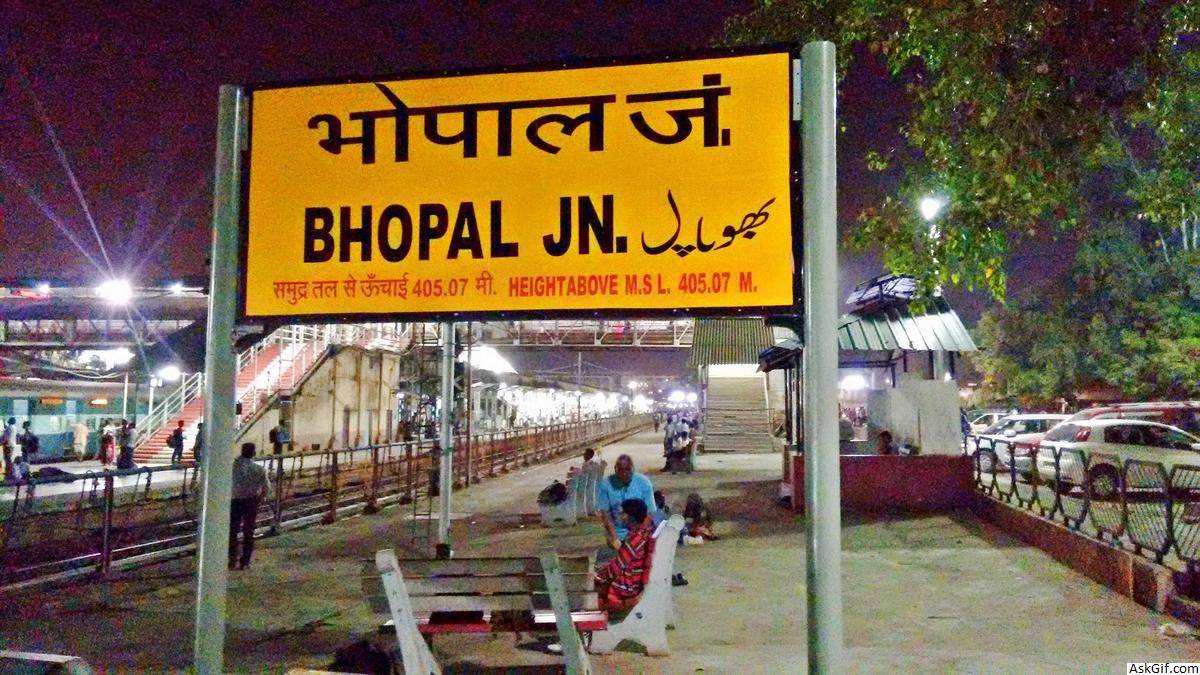
Bhopal lies in the West Central Railway Zone. Considering both North-South and East-West train routes, it is one of the most rail connected cities in India which halts more than 200 daily trains, with a total of more than 380 trains within a week. The main stations of Bhopal are the Bhopal Junction station located in old Bhopal as well as Bhopal Habibganj station located in new Bhopal. Both of the stations are equipped with WiFi, has enough waiting halls, refreshment center, passenger ticket counter and ticket vending machines, vehicle parking, communication facility, sanitary facility and dedicated government railway police force to ensure security. Altogether the city has six railway stations within its city limits.
The Bhopal Junction station as well as Bhopal Habibganj station are selected along with 47 other railway stations to emerge as The World Class Railway Station. While the work has already started on development of Bhopal Habibganj as the first world class railway station of India. The Bhopal Junction and Bhopal Habibganj have already received ISO 9001:2000 certificate.
Roads
Bhopal VIP road
National Highway No.12 passes through Bhopal which connects it to Jabalpur in the East and Jaipur in the West. National Highway 86 connects Bhopal to Sagar in the East to Dewas & Ujjain in the West. State Highway 17 connects the city with Indore.
Kushabhau Thakre ISBT Bhopal
An interstate bus terminus is located near the Habibganj railway station, called the Kushabhau Thakre Inter State Bus Terminal which was inaugurated in 2011.
Urban transport
Bhopal BRTS
The Bus Rapid Transit System, which opened in 2013, is run by Bhopal City Link Limited (BCLL). The company has identified 4 trunk and 8 standard routes in the city on which 225 buses would be operated daily (365 a day in a year), from 5 a.m. to 11 p.m. 82 bus stops are built along the 24 km long corridor.
Metro Rail
A metro rail project is under construction for the city.
Education
See also: List of educational institutions in Bhopal
Basic education
National Law Institute University
Bhopal has more than 550 state-sponsored schools, which are affiliated to the Madhya Pradesh Board of Secondary Education (MPBSE). In addition, there are five Kendriya Vidyalayas in the city, affiliated to the Central Board of Secondary Education (CBSE). The city is also served by numerous other private schools affiliated to either CBSE, ICSE, MPBSE, NIOS and CIE (Cambridge).
Schools include Delhi Public School, Bhopal (CBSE), The Sanskaar Valley School (ICSE & Cambridge International Examinations), Campion School (CBSE) and St. Joseph's Convent (CBSE).
Higher education
IIFM arc
There are many universities in Bhopal and its fifteen Institutions of National Importance is the highest number of any town in India outside New Delhi. The institutes and universities headquartered in the city include:
Institute Founded
Gandhi Medical College 1955
Maulana Azad National Institute of Technology 1960
Barkatullah University 1970
Indian Institute of Forest Management 1982
Madhya Pradesh Bhoj Open University 1991
National Law Institute University 1997
Rajiv Gandhi Proudyogiki Vishwavidyalaya 1998
Makhanlal Chaturvedi National University of Journalism and Communication 1990
National Judicial Academy 1993
Sagar Institute of Research & Technology 2003
Indian Institute of Science Education and Research, Bhopal 2008
National Institute of Fashion Technology 2008
School Of Planning And Architecture 2008
All India Institute of Medical Science 2012
Jagran Lakecity University 2013
Indian Institute of Information Technology 2017
RKDF University 2012
Rabindranath Tagore University 2010
Sports
Teams
Bhopal Badshahs is a hockey team based in Bhopal that plays in World Series Hockey. The team is captained by Indian hockey player Sameer Dad and coached by Vasudevan Bhaskaran who was the captain of India's Olympic victory in 1980 Summer Olympics in Moscow. Badshahs defeated Chandigarh Comets in the inaugural match of 2012 World Series Hockey 4-3. Aishbagh Stadium in Bhopal is the home ground of Bhopal Badshahs.
Stadiums
Aishbagh Stadium is a field hockey stadium in Bhopal.
TT Nagar Stadium is a multi-purpose stadium is Bhopal.
Places of interest
Nature
Bhimbetka pre-historic rock cave painting near Bhopal include 500 sandstone caves and shelters. These are dated to range from 12,000 years ago to chalcolithic era of human history. They are a UNESCO World Heritage site.
Bhimbetka Caves are about 35 kilometres from Bhopal city. They have evidence of dwellings of pre-historic man during the Paleolithic era. Rock paintings in the caves are specimens of pre-historic settlements in India. There are about 600 caves, but only 12 are open for visitors. The caves are located in the midst of sal and teak forests and includes a short trail around the caves. They were discovered by Wakankar in 1957. UNESCO declared Bhimbetka Caves as a World Heritage Site in 2003.
Van Vihar National Park is a national park in central India. It is located in Bhopal, the capital city of Madhya Pradesh. Declared a national park in 1979, it covers an area of about 4.45 km2. Although it has the status of a national park, Van Vihar is developed and managed as a modern zoological park, following the guidelines of the Central Zoo Authority. The animals are kept in their near natural habitat. Most of the animals are either orphaned brought from various parts of the state or those, which are exchanged from other zoos. No animal is deliberately captured from the forest. Van Vihar is unique because it allows easy access to the visitors through a road passing through the park, security of animals assured from poachers by building trenches and walls, chain-link fence and by providing natural habitat to the animals.
Activity centres
The Museum of Mankind in Bhopal exhibits tribal and folk houses from all corners of India.
People from Bhopal
Shankar Dayal Sharma – 9th President of India
Abdul Hafiz Mohamed Barakatullah – Revolutionary
Aslam Sher Khan – National hockey player and Member of Parliament
Divyanka Tripathi – Actress
Vipul Roy – Actor
Eisha Singh – Actress
Najma Heptulla – Union Minister
Raghuram Rajan – 23rd Governor Of RBI
Arshi Khan – Actress, model
Shawar Ali – Actor
Javed Akhtar – Poet and lyricist graduated from Saifia College, Bhopal
Asad Bhopali – Poet and lyricist
Kaif Bhopali – Poet and lyricist
Manzar Bhopali – Urdu poet
Manzoor Ahtesham – Writer and Padma Shri award recipient
Mansoor Ali Khan Pataudi – Former Captain of the India national cricket team
Sara Khan (TV actress)
Shahryar Khan – Chairman of Pakistan Cricket Board
Annu Kapoor – Actor, TV presenter and National Film Award winner
Kailash Chandra Joshi – Former Chief Minister of Madhya Pradesh
Abdul Qadeer Khan – Pakistani nuclear physicist
Shoaib Ibrahim – TV Actor
Sameer Dad – National hockey player
Jalaluddin Rizvi – National hockey player and Arjuna Award winner
Anees Ahmed – Lawyer in United Nations Peacekeeping Operations and United Nations International Criminal Tribunals
Jaya Bachchan – Actress
Bashir Badr – Urdu poet
Saumya Tandon – Television actress
Bhagwat Rawat - Poet and essayist
Bhopal disaster
Main article: Bhopal disaster
In early December 1984, a Union Carbide India Limited pesticide plant in Bhopal leaked around 32 tons of toxic gases, including methyl isocyanate (MIC) gas which led to the worst industrial disaster in the world to date.
The official death toll was initially recorded as around 4,000. A Madhya Pradesh government report stated 3,787 deaths, while other estimates state the fatalities were significantly higher (16,000) from the accident and the medical complications caused by the accident in the weeks and years that followed. The higher estimates have been challenged. The impact of the disaster continues to this day in terms of psychological and neurological disabilities, blindness, skin, vision, breathing, and birth disorders.
The soil and ground water near the factory site have been contaminated by the toxic wastes. The Bhopal disaster continues to be the part of the socio-political debate; the clean-up of environmental contamination and rehabilitation of those affected continues to challenge the people of Bhopal.
source: https://en.wikipedia.org/wiki/Bhopal