Jammu is the winter capital and the largest city in Jammu district of the Indian state of Jammu and Kashmir. Lying on the banks of the river Tawi, the city of Jammu, with an area of 26.64km², is surrounded by the Himalayas in the north and the northern-plains in the south. Jammu is the second most populous city of the state.
Known as the City of Temples for its ancient temples and Hindu shrines, Jammu is the most visited place in the state. Jammu city shares its borders with the neighbouring Samba district.
Transport
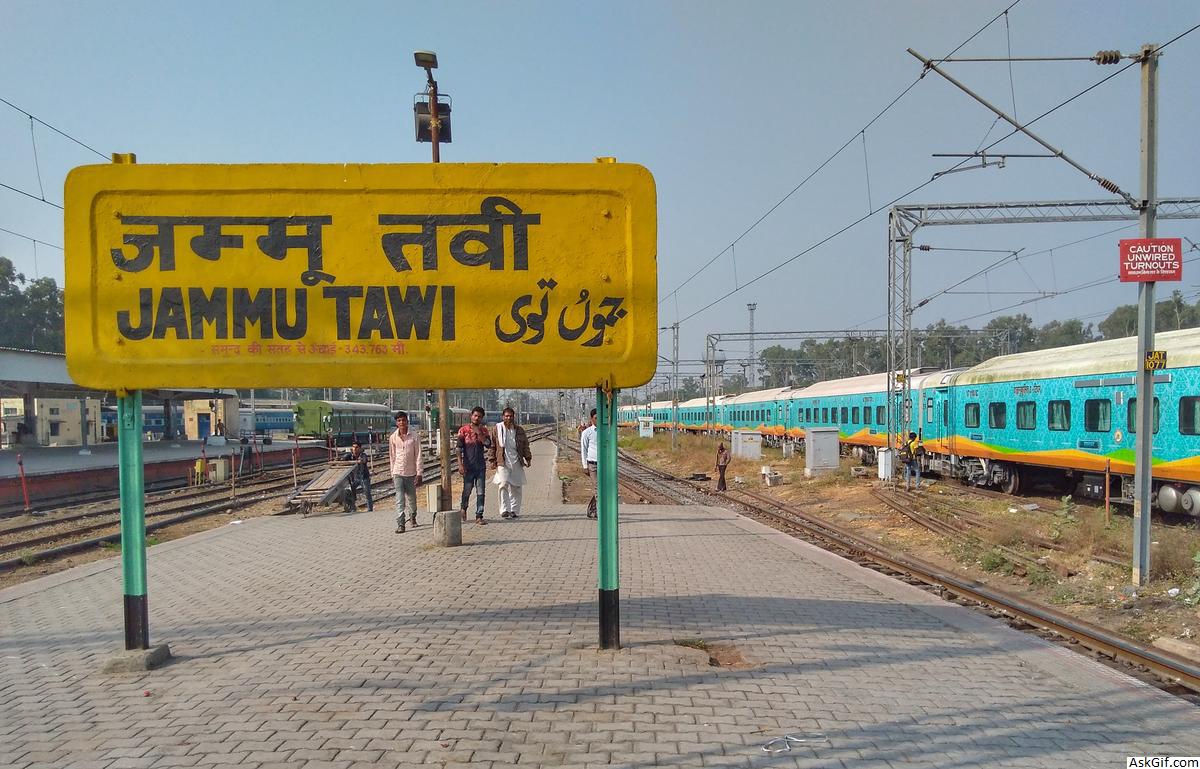
Jammu Tawi station
Jammu city has a railway station called Jammu Tawi (station code JAT) that is connected with major cities of India. The old railway link to Sialkot was broken after the Partition of India and Jammu had no rail services until 1971, when the Indian Railways laid the Pathankot - Jammu Tawi Broad Gauge line. The new Jammu Tawi station was opened in October 1972 and is an origination point for Express trains. With the commencement of the Jammu–Baramulla line, all trains to the Kashmir Valley will pass through Jammu Tawi. A part of the Jammu–Baramulla project has been executed and the track has been extended to Katra. Jalandhar - Pathankot - Jammu Tawi section has been doubled and electrified.
National Highway 1A
National Highway 1A which passes through Jammu connects it to the Kashmir valley. National Highway 1B connects Jammu with Poonch town. Jammu is just 80 kilometres (50 mi) from Kathua town, while it is 68 kilometres (42 mi) from Udhampur city. Katra is also 49 kilometres (30 mi) away.
Jammu Airport is in the middle of Jammu. It has direct flights to Srinagar, Delhi, Amritsar, Chandigarh, Leh and Mumbai and Bengaluru. Jammu Airport operate daily 30 arrival and departure flights which is Goair, Air India, Spicejet and Indigo running daily flights.
The city has JKSRTC city buses under and minibusses for local transport which run on some defined routes. These minibusses are called "Matadors". Besides this auto-rickshaw and cycle-rickshaw service is also available. Local taxis are also available.
Tourism
Tourism is the largest industry in Jammu city. It is also a focal point for the pilgrims going to Vaishno Devi and Kashmir valley as it is second last railway terminal in North India. All the routes leading to Kashmir, Poonch, Doda and Laddakh start from Jammu city. So throughout the year, the city remains full of people from all the parts of India. Places of interest include old historic palaces like Mubarak Mandi Palace, Purani Mandi, Rani Park, Amar Mahal, Bahu Fort, Raghunath Temple, Ranbireshwar Temple, Karbala, Peer Meetha, Old city.
Education
In the 2014–2015 General Budget of India, Arun Jaitley, the Finance Minister of India, proposed an Indian Institute of Technology and an Indian Institute of Management for the division. List of some educational institutions is provided below.
Engineering Colleges in Jammu:-
Indian Institute of Technology Jammu
Government College of Engineering and Technology, Jammu
Model Institute of Engineering and Technology, Jammu
Yogananda College of Engineering and Technology, Jammu
Medical Institutions:-
Indian Institute of Integrative Medicine, CSIR
Government Medical College, Jammu
Legal Institutions:-
Kishen Chand Law College, Jammu
Dogra Law College, Jammu
Calliope School of Legal Studies, Jammu
R. K. Law College, Jammu
General Degree Courses (colleges):-
Govt. Gandhi Memorial Science College, Jammu
Govt. MAM PG College, Jammu
Universities:-
Central University of Jammu
Sher-e-Kashmir University of Agricultural Sciences and Technology of Jammu
University of Jammu
Cuisine
Jammu is known for its sund panjeeri, patisa, rajma with rice and Kalari cheese. Dogri food specialties include ambal, khatta meat, kulthein di dal, dal patt, maa da madra, rajma, and auriya. Pickles typical of Jammu are made of kasrod, girgle, mango with saunf, jimikand, tyaoo, seyoo, and potatoes. Auriya is a dish made with potatoes. Jammu cuisine features various chaats, especially gol gappas, kachalu, Chole bhature, gulgule, rajma kulche and dahi palla, among various others.
Refugees and migration
See also: Exodus of Kashmiri Hindus and 2015 Rohingya refugee crisis
Being comparatively safe from terrorism, Jammu city has become a hub of refugees. These primarily include Kashmiri Hindus who migrated from Kashmir Valley in 1989. Hindus from Pakistan administered Jammu and Kashmir who migrated to India have also settled in Jammu city. As per the records approximately 31,619 Hindu families had migrated from Pakistan administered Jammu and Kashmir to India, out of them 26,319 families are settled in Jammu. Rohingyas who fled Myanmar during 2016 have also currently settled in Jammu. Settlements of Rohingya Muslims have also raised security threats in Jammu. During the 2018 Sunjuwan attack, intelligence agencies had suspected involvement of Rohingya Muslims in the attack.
source: https://en.wikipedia.org/wiki/Jammu