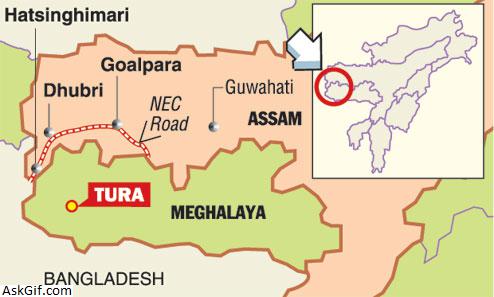
South Salmara Mankachar is an administrative district in the state of Assam in India. The district headquarters are located at Hatsingimari village which is situated at about 245 km from Guwahati. Earlier it was a sub-division of Dhubri District.
Etymology
The name South Salmara Mankachar comes from the Legislative constituency South Salmara.
History
South Salmara Mankachar was created by bifurcating Old Dhubri district in 2016. On 15 August 2015 Assam's Chief Minister Tarun Gogoi announced 5 new administrative district in Assam; South Salmara Mankachar was one among those. On 9 February 2016 Commissioner, Lower Assam and Central Assam Division Md. Mahtab Uddin Ahmed, IAS inaugurated South Salmara Mankachar as an administrative district at a function in Hatsingimari with the presence of thousands of people.
Geography
South Salmara Mankacahr district occupies an area of 568 square kilometres (219 sq mi). It occupies 980/km 2 (2,500/sq mi) of density and is an administrative district in the state of Assam in India. The district headquarters are located at Hatsingimari town which is situated at about 245 km from Guwahati, the state capital. Earlier it was a sub-division of Dhubri District. It shares its borders with Bangladesh in the west and Meghalaya in the south-east.
Economy
South Salmara Mankachar District is primarily dependent on agricultural and forest products. The main source of income is paddy (both winter and autumn) with surplus production. Jute and mustard seed occupy the major share of cash crops. Wheat, maize, pulses and sugarcane are also grown moderately. From forest, mainly timber and bamboo add to the income, though boulders and sand are also available. Fish, milk, meat, and eggs have small contributions to the economy. Currently, three tea gardens, whose contribution to the district economy is almost negligible, cover an area of 1362.33 hectares. Land revenue collection is minimal, whereas tax from check gates and excise duty occupy much of the government exchequer. Devoid of major industrial production, the district uses more funds for administration, development, and welfare works than it provides.
Its rich natural wealth is yet to be explored and some believe that proper utilization of natural resources could provide a boost for the struggling economy.
Divisions
There are one Sub-Division(Sadar) and 2 Revenue Circles:
South Salmara Revenue Circle Office
Hatsingimari (Sadar)
Mankachar Revenue Circle Office
There is a Census Town: Mankachar.
The district has 3 police stations.
There are two Assam Legislative Assembly constituencies in this district: 21 Mankachar, 22 South Salmara. All two are in the Dhubri Lok Sabha constituency.
Demographics
The general topography of South Salmara Mankachar district is plain with patches of small hillocks like Bansali, Rangatari, etc. All these are situated in the southwestern part of the district. Mighty river Brahmaputra is flowing through this district from east to west with its tributaries. Other rivers are Jinjiram, Kalonadi, etc. The average annual rainfall of the district is 2,916 mm.
Historical Sites
There are few historical sites in the district. However, the famous ones are the tomb of Mir Jumla and Kamakhya Temple at Mankachar.
Education
There are several renowned govt. and private schools and colleges in Hatsingimari area. Some of them are
Sarbajanin Hatsingimari Jatiya Vidyalaya,
Rainbow English Academy, Hatsingimari
Hatsingimari Science Academy,Hatsingimari
Magnet Academy , Hatsingimari
Assam Professional Academy, Hatsingimari
Namoni Axam Jatiya Vidyalaya
Shankar Azaan Jatiya Vidyalaya
Elite Academy
Hatsingimari Junior College, Hatsingimari
Hatsingimari College,Hatsingimari
Vision National Academy, Kharuabandha
Apollo Academy,Hatsingimari
Elegant English Academy,Hatsingimari
Ajmal college of arts & science, Hatsingimari
Moreover, there are many private coaching and tuition classes in this place. Students from Meghalaya and other parts of the district comes here for their schooling.
Culture
The culture of the people in this district is a fusion of Assamese and Bengali cultures. About 85% population are Muslims, 14% are Hindu and rest 1% are Christians and Sikhs. Most of the people speak Goalparia Assamese (Deshi) and some people speak Mymensinghi Bengali (of Bangladesh). Those who speak Goalparia Assamese are called Ujani or Deshi and those who speak Mymensinghi Bengali are called Bhatiya in the district. There are few many differences between the Ujani and Bhatiya cultures. Ghoti and Tribal peoples, who are few in numbers also contribute to the culture of the district.
source: https://en.wikipedia.org/wiki/South_Salmara_district