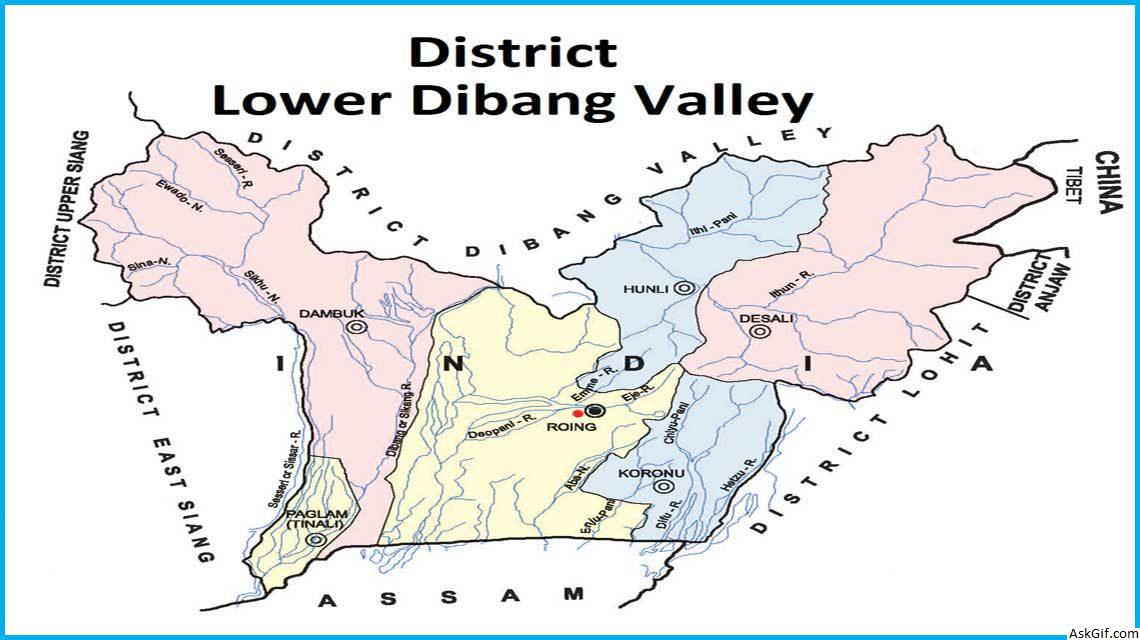
The Lower Dibang Valley district is an administrative district in the state of Arunachal Pradesh in northeastern India. It is the tenth least populous district in the country (out of 707).
History
Snow-clad mountain
The area of the present district was an integral part of the Chutiya Kingdom from the 12th to the 16th century. In June 1980, Dibang Valley district was created out of part of Lohit district. On 16 December 2001, Dibang Valley district was bifurcated into Dibang Valley district and Lower Dibang Valley district. This district is credited significantly for producing 1st in the state of Arunachal, the likes such as:-
1) Gora Pertin, first Pro-temporary Speaker of Arunachal Pradesh Legislative Assembly (1975)
2) Jomin Tayeng, first IAS (direct recruit through UPSC, 1967), first L.L.B (Law Graduate, 1967) in Arunachal Pradesh.
3) Tine Mena (1st women to climb Mt. everest) from Arunachal Pradesh.
4) Anayok James Tayeng, first IAS (Indian Administrative Service) officer (by induction), 1964.
5) Mukut Mithi, first person to become Lieutant Governor from the state of Arunachal Pradesh.
6) Dr. Marak Pertin, first Navy Doctor from Arunachal Pradesh.
7) Mrs Rukluki Lego, First ANM (Auxiliary Nursing Midwife), 1951 batch from Arunachal Pradesh.
8) Dugyon Lego, first person to publish a book called PADAM KITAB in Roman Script for elementary education in indigenous dialect in the year 1935.
Geography
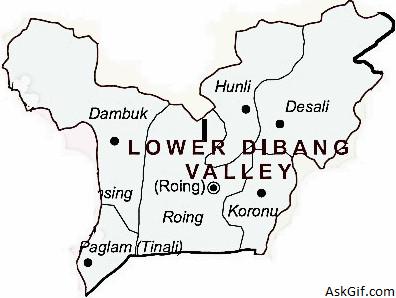
The district headquarters of the district is Roing. Before it was carved out on 16 December 2001, Anini was the district headquarters.
Transport
The 2,000-kilometre-long (1,200 mi) proposed Mago-Thingbu to Vijaynagar Arunachal Pradesh Frontier Highway along the McMahon Line, (will intersect with the proposed East-West Industrial Corridor Highway) and will pass through this district, alignment map of which can be seen here and here.
Divisions
There are two Arunachal Pradesh Legislative Assembly constituencies located in this district: Dambuk and Roing. Both are part of Arunachal East Lok Sabha constituency.
Demographics
According to the 2011 census Lower Dibang Valley district has a population of 53,986, roughly equal to the nation of Saint Kitts and Nevis. This gives it a ranking of 630th in India (out of a total of 640). The district has a population density of 14 inhabitants per square kilometre (36/sq mi) . Its population growth rate over the decade 2001–2011 was 7.01%. Lower Dibang Valley has a sex ratio of 919 females for every 1000 males, and a literacy rate of 70.38%.
Languages
Major Languages spoken include Idu (local language with highest number of speakers) and Adi. Hindi has been imposed extensively on children in kindergarten since 1970s. Most of the citizens now understand and speak Hindi. Several other languages are spoken too in various pockets such as Nepali, Assamese etc. by people who primarily provide labour in farms, tea gardens etc. English too is abundantly spoken by educated citizens.
Flora and fauna
The district is rich in wildlife. Rare mammals such as Mishmi takin, red goral, elephant, wild water buffalo and leaf muntjac occur while among birds there is the rare Sclater's monal, Blyth's tragopan, rufous-necked hornbill, Bengal florican, white-winged wood duck. A flying squirrel, new to science, i.e., Mishmi Hills giant flying squirrel (Petaurista mishmiensis) also occurs in this district.
In 1980 Lower Dibang Valley district became home to the Mehao Wildlife Sanctuary, which has an area of 282 km2 (108.9 sq mi).
Handicraft
The Idus are expert craftsman. The Idu women, in particular, are very good weavers. Their great aesthetic sense is well reflected in the exquisite designs created on the clothes produced on handlooms. The Idu men are well apt in making beautiful basketry items of bamboo and cane
Handicrafts of the Adis are best seen in their cane and bamboo works. Baskets, trays, haversacks, mats and hats and headgears with artistic designs are produced for domestic use.
Women are expert weavers. Their home productions, like coats, jackets, bags, skirts, shawls and blankets displaying their abilities in handloom.
source: https://en.wikipedia.org/wiki/Lower_Dibang_Valley_district