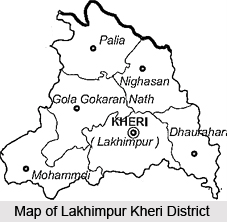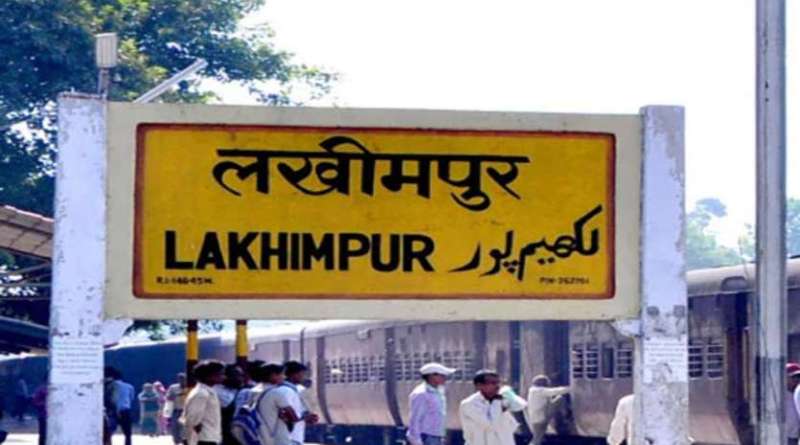
Lakhimpur is a city and a municipal board in Lakhimpur Kheri district in the Indian state of Uttar Pradesh.
Education
Education is available at the Junior and Senior Basic Schools, Senior Secondary Schools and college level.
St. Don Bosco's College
Lakhimpur Kheri has a majority of small schools with limited enrollments. However the bigger ones include St. Don Bosco's College and B.P.S. Public School. Other schools and colleges are Pt. Deen Dayal Upadhyaya Saraswati Vidya Mandir Inter College, Government Inter College, Govt Girls' Inter college, Dharm Sabha Inter college, Arya Kanya, St. John's School in Gola Gokarannath, Lucknow Public School, C.B. Singh Gaur Memorial School, Cane Growers Inter College, Greenfield Academy, Children's Academy, Ajmani International School, Kunwar Khuswaqt Rai, Adarsh Vidya Mandir, Saraswati Vidya Mandir, Paul International School and City Montessori Kheri.
Tourism
Dudhwa
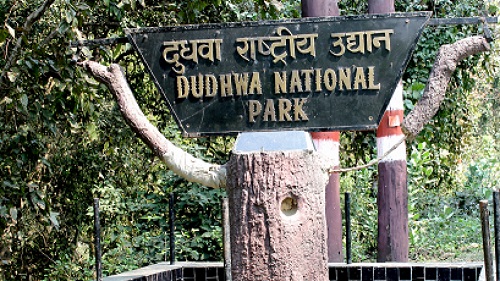
Dudhwa Tiger Reserve (DTR) has two core areas, Dudhwa National Park[10] and Kishanpur Wildlife Sanctuary, which were merged in 1987. Dudhwa National Park is known as the first National Park of the state after the formation of Uttarakhand.
It is home to a large number of rare and endangered species including Tiger, Leopard cat, Rhinoceros (one-horned), Hispid hare, Elephants, Black deer, Swamp deer, etc.
A bird watchers' haven, Dudhwa is noted for its avian variety – about 400 species. Its swamps and several lakes attract varieties of waterfowl. Being close to the Himalayan foothills, Dudhwa also gets its regular winter visitors – the migratory water birds. The Banke Tal is perhaps the most popular spot for bird watchers. There are egrets, cormorants, herons and several species of duck, geese and teal.
Conservation History
The visit of Sir D.B. Brandis in 1860 to the area culminated in a 303 square miles (780 km2) forest area of the present day Dudhwa National Park being brought under the control of Government in 1861 for preservation.[11] In Kheri District all the Sal and miscellaneous forests and grasslands in Kharigarh Pargana, between the Mohana and Suheli rivers, were included in the then North Kheri Forest Division. More areas were reserved for protection between 1867 and 1879 and added to the Division. The area of the Division was legally constituted as Reserved Forests in 1937.
The Sonaripur Sanctuary, comprising 15.7 km2, was created in 1958 to specifically protect swamp deer (Cervus duvaceli duvaceli). The area was too small and was later enlarged to 212 km2 and renamed as Dudhwa Sanctuary in 1968. Later, more area was added to the Sanctuary and in 1977, it was declared Dudhwa National Park. The total area of the Park was 616 km2 of which 490 km2 was the core zone and the balance of 124 km2 was a buffer zone.
The area was established in 1958 as a wildlife sanctuary. On 1 February 1977 wildlife sanctuary became a national park and after 11 years in 1988 it was established as a tiger reserve. Dudhwa Tiger Reserve lies on the India-Nepal border in the foothills of the Himalaya. Dudhwa Tiger Reserve was created in the year 1987–88 comprising Dudhwa National Park and Kishanpur Sanctuary (203.41 km2). With an addition of 66 km2 to the buffer zone in 1997, the present area of the Tiger Reserve is 884 km2. Distance from Lakhimpur railway station to Dudhwa is about 100 km by road. Sharda Dam and Deer Park are other major attractions of Lakhimpur.
source: https://en.wikipedia.org/wiki/Lakhimpur,_Uttar_Pradesh