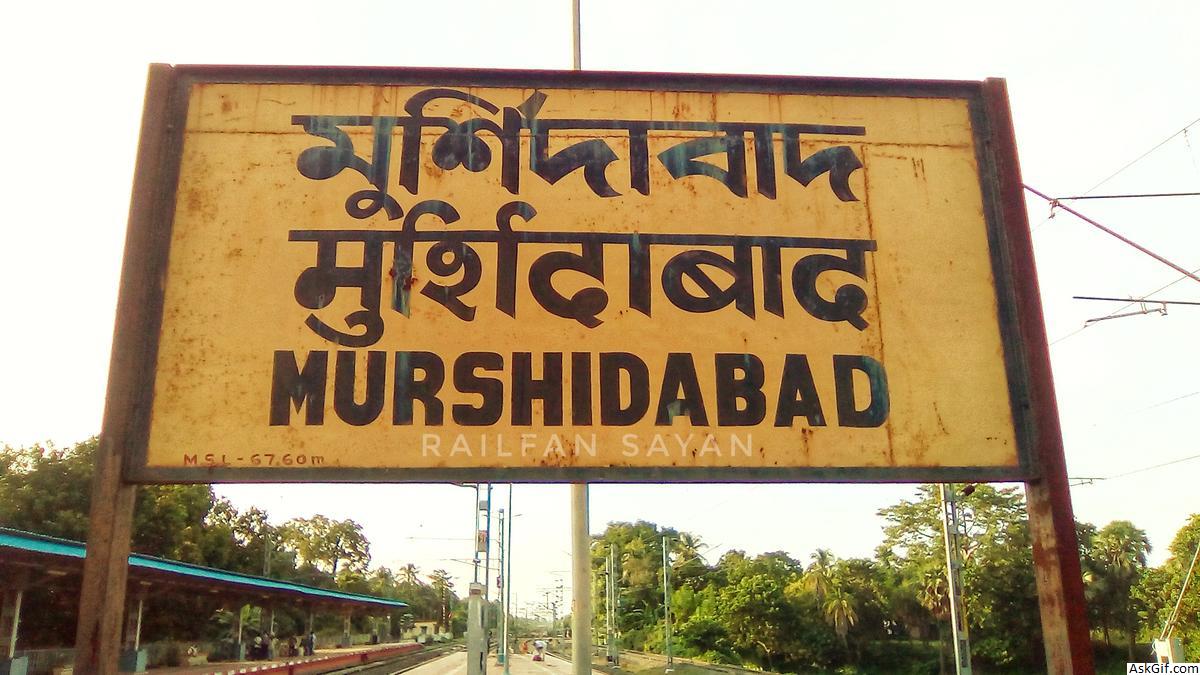
Murshidabad district is a district of in the Indian state of West Bengal. Situated on the left bank of the river Ganges, the district is very fertile. Covering an area of 5,341 km² (2,062 sq mi) and having a population 7.103 million (according to 2011 census),it is a densely populated district and the ninth most populous in India (out of 640). Baharampur town is the headquarters of the district.
The Murshidabad city, which lends its name to the district, was the seat of power of the Nawabs of Bengal. All of Bengal was once governed from this town. A few years after Nawab Siraj-ud-Daula lost to the British at the Battle of Plassey, the capital of Bengal was moved to the newly founded city of Calcutta.
Transport
Surface transport (road and rail) is the most important way of transport. Even though a major river runs through the district (Bhagirathi), water transport is not very common, even though small boats ferry people across rivers where no bridge is available. one main bridge name Ramendrasundar Tribedi.
Road
Buses are the most common form of transport, and they are easily available, and run to a wide range of destinations within and without the district. Bus transport is cheap (For example, a journey of 182 km to Kolkata from Baharampur costs about Rs. 135) Trucks carry majority of goods transported in the district. Overloaded trucks on the road are also a common sight, and they are a major reason roads are in bad condition.
Rail
There are two major rail routes. The major line runs north-south and connects the district to Kolkata and North Bengal. There is another line that branches out from this line at Azimganj and connects the Sahebgunj loop at Nalhati (Birbhum.)
Divisions
Administrative subdivisions
The district comprises five subdivisions: Barhampur, Domkol, Lalbag, Kandi and Jangipur. Other than municipality area, each subdivision contains community development blocks which in turn are divided into rural areas and census towns. In total there are 29 urban units: 8 municipalities and 22 census towns. Baharampur and Kasim Bazar together form an urban agglomeration.
Barhampur consists of Baharampur municipality, Beldanga municipality, and five community development blocks: Berhampore, Beldanga I, Beldanga II, Hariharpara and Naoda. Domkol subdivision consists of Domkol (municipality) and three community development blocks:[Raninagar I]], Raninagar II and Jalangi. Lalbag subdivision consists of Murshidabad municipality, Jiaganj-Azimganj municipality and five community development blocks: Murshidabad-Jiaganj, Bhagawangola I, Bhagawangola II, Lalgola and Nabagram. Kandi subdivision consists of Kandi municipality and five community development blocks: Kandi, Khargram, Burwan, Bharatpur I and Bharatpur II. Jangipur subdivision consists of Jangipur municipality, Dhulian municipality and seven community development blocks: Raghunathganj I, Raghunathganj II, Suti I, Suti II, Samserganj, Sagardighi and Farakka. There are 26 police stations, 26 development blocks, 8 municipalities, 254 gram panchayats and 1937 villages in this district.
Sub-division
Berhampore
Lalbagh
Kandi
Jangipur
Places of interest
The grounds of the Nizamat Imambara
Khushbagh is the cemetery of the last independent rulers of Murshidabad
Of historic interest are Nizamat Kila (the Fortress of the Nawabs), also known as the Hazaarduari Palace (Palace of a Thousand Doors), built by Duncan McLeod of the Bengal Engineers in 1837, in the Italianate style, the Moti Jhil (Pearl Lake) just to the south of the palace, the Muradbagh Palace and the Khushbagh Cemetery, where the remains of Ali Vardi Khan and Siraj Ud Daulah are interred.
Hazarduari Palace is located in the campus of Kila Nizamat of Murshidabad. It was built in the nineteenth century by architect Duncan Macleod, under the reign of Nawab Nazim Humayun Jah of Bengal, Bihar and Orissa (1824–1838). The foundation stone of the palace was laid on 9 August 1829, and that very day the construction work was started. William Cavendish was the then Governor-General. Now, Hazarduari Palace is the most conspicuous building in Murshidabad. In 1985, the palace was handed over to the Archaeological Survey of India for better preservation.
The present Nizamat Imambara was built in 1847 AD by Nawab Nazim Mansoor Ali Khan Feradun Jah, who succeeded his father Nawab Nazim Humayun Jah in Murshidabad, India. It was built after the fires of 1842 and 1846 which burnt the wooden Imambara built by Nawab Siraj ud-Daulah. This Imambara is the largest one in India and Bengal.
The Katra Masjid (also known as Katra Mosque) is a mosque and the tomb of Nawab Murshid Quli Khan built between 1723 and 1724. It is located in the north eastern side of the city. Its importance lies not only as a great centre of Islamic learning but also for the tomb of Murshid Quli Khan, who is buried under the entrance staircase. The most striking feature is the two large corner towers having loopholes for musketry. At present it is maintained and protected by the Archaeological Survey of India and the Government of West Bengal.
Bacchawali Tope is a gun, rather cannon which lies in the Nizamat Fort Campus on the garden space between the Nizamat Imambara and the Hazarduari Palace and to the east of the old Madina Mosque. The cannon consists two pieces of different diameters. The cannon was made between the 12th and 14th century, probably by the Mohammeddan rulers of Gaur. It originally lied on the sand banks of Ichaganj. However, it is unknown that how it came in Ichaganj. It was used to protect the city of Murshidabad from north-western attacks. After the 1846 fire of the Nizamat Imambara the Imambara was rebuilt, then after the completion of the new Imambara the cannon was shifted to its present site by Sadeq Ali Khan, the architect of the sacred Nizamat Imambara under the suggestion of Sir Henry Torrens, the then agent of the Governor General at Murshidabad.
Notable residents
Nawabs
Murshid Kuli Khan
Iskander Mirza
Siraj ud-Daulah
Literature
Manish Ghatak
Mahasweta Devi
Rakhaldas Bandyopadhyay
Sarat Chandra Pandit
Ramendra Sundar Tribedi
Syed Mustafa Siraj
Arup Chandra
Govindadasa
Abul Bashar
Nabarun Bhattacharya
Nirupama Devi
Music, painting and performing arts
Shreya Ghoshal
Arijit Singh
Mir Afsar Ali
Amiya Kumar Bagchi
Abul Hayat
Farida Yasmin
Tapan Sinha
Basu Bhattacharya
Freedom fighters
Abul Barkat
Sportsmen
Karuna Bhattacharya
Religion
Raja Ram Mohan Roy
source: https://en.wikipedia.org/wiki/Murshidabad_district