Step 1: Outline use cases and constraints Gather requirements and scope the problem. Ask questions to clarify use cases and constraints. Discuss assumptions.
Without an interviewer to address clarifying questions, we'll define some use cases and constraints.
Use cases We'll scope the problem to handle only the following use cases User searches for someone and sees the shortest path to the searched person Service has high availability Constraints and assumptions
State assumptions Traffic is not evenly distributed Some searches are more popular than others, while others are only executed once Graph data won't fit on a single machine Graph edges are unweighted 100 million users 50 friends per user average 1 billion friend searches per month Exercise the use of more traditional systems - don't use graph-specific solutions such as GraphQL or a graph database like Neo4j
Calculate usage Clarify with your interviewer if you should run back-of-the-envelope usage calculations.
5 billion friend relationships 100 million users * 50 friends per user average 400 search requests per second Handy conversion guide:
2.5 million seconds per month 1 request per second = 2.5 million requests per month 40 requests per second = 100 million requests per month 400 requests per second = 1 billion requests per month Step 2: Create a high level design Outline a high level design with all important components.
Imgur
Step 3: Design core components Dive into details for each core component.
Use case: User searches for someone and sees the shortest path to the searched person Clarify with your interviewer how much code you are expected to write.
Without the constraint of millions of users (vertices) and billions of friend relationships (edges), we could solve this unweighted shortest path task with a general BFS approach:
class Graph(Graph):
def shortest_path(self, source, dest): if source is None or dest is None: return None if source is dest: return [source.key] prev_node_keys = self._shortest_path(source, dest) if prev_node_keys is None: return None else: path_ids = [dest.key] prev_node_key = prev_node_keys[dest.key] while prev_node_key is not None: path_ids.append(prev_node_key) prev_node_key = prev_node_keys[prev_node_key] return path_ids[::-1]
def _shortest_path(self, source, dest): queue = deque() queue.append(source) prev_node_keys = {source.key: None} source.visit_state = State.visited while queue: node = queue.popleft() if node is dest: return prev_node_keys prev_node = node for adj_node in node.adj_nodes.values(): if adj_node.visit_state == State.unvisited: queue.append(adj_node) prev_node_keys[adj_node.key] = prev_node.key adj_node.visit_state = State.visited return None We won't be able to fit all users on the same machine, we'll need to shard users across Person Servers and access them with a Lookup Service.
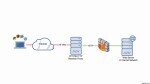
The Client sends a request to the Web Server, running as a reverse proxy The Web Server forwards the request to the Search API server The Search API server forwards the request to the User Graph Service The User Graph Service does the following: Uses the Lookup Service to find the Person Server where the current user's info is stored Finds the appropriate Person Server to retrieve the current user's list of friend_ids Runs a BFS search using the current user as the source and the current user's friend_ids as the ids for each adjacent_node To get the adjacent_node from a given id: The User Graph Service will again need to communicate with the Lookup Service to determine which Person Server stores theadjacent_node matching the given id (potential for optimization) Clarify with your interviewer how much code you should be writing.
Note: Error handling is excluded below for simplicity. Ask if you should code proper error handing.
Lookup Service implementation:
class LookupService(object):
def __init__(self): self.lookup = self._init_lookup() # key: person_id, value: person_server
def _init_lookup(self): ...
def lookup_person_server(self, person_id): return self.lookup[person_id] Person Server implementation:
class PersonServer(object):
def __init__(self): self.people = {} # key: person_id, value: person
def add_person(self, person): ...
def people(self, ids): results = [] for id in ids: if id in self.people: results.append(self.people[id]) return results Person implementation:
class Person(object):
def __init__(self, id, name, friend_ids): self.id = id self.name = name self.friend_ids = friend_ids User Graph Service implementation:
class UserGraphService(object):
def __init__(self, lookup_service): self.lookup_service = lookup_service
def person(self, person_id): person_server = self.lookup_service.lookup_person_server(person_id) return person_server.people([person_id])
def shortest_path(self, source_key, dest_key): if source_key is None or dest_key is None: return None if source_key is dest_key: return [source_key] prev_node_keys = self._shortest_path(source_key, dest_key) if prev_node_keys is None: return None else: # Iterate through the path_ids backwards, starting at dest_key path_ids = [dest_key] prev_node_key = prev_node_keys[dest_key] while prev_node_key is not None: path_ids.append(prev_node_key) prev_node_key = prev_node_keys[prev_node_key] # Reverse the list since we iterated backwards return path_ids[::-1]
def _shortest_path(self, source_key, dest_key, path): # Use the id to get the Person source = self.person(source_key) # Update our bfs queue queue = deque() queue.append(source) # prev_node_keys keeps track of each hop from # the source_key to the dest_key prev_node_keys = {source_key: None} # We'll use visited_ids to keep track of which nodes we've # visited, which can be different from a typical bfs where # this can be stored in the node itself visited_ids = set() visited_ids.add(source.id) while queue: node = queue.popleft() if node.key is dest_key: return prev_node_keys prev_node = node for friend_id in node.friend_ids: if friend_id not in visited_ids: friend_node = self.person(friend_id) queue.append(friend_node) prev_node_keys[friend_id] = prev_node.key visited_ids.add(friend_id) return None We'll use a public REST API:
$ curl https://social.com/api/v1/friend_search?person_id=1234 Response:
{ "person_id": "100", "name": "foo", "link": "https://social.com/foo", }, { "person_id": "53", "name": "bar", "link": "https://social.com/bar", }, { "person_id": "1234", "name": "baz", "link": "https://social.com/baz", }, For internal communications, we could use Remote Procedure Calls.
Step 4: Scale the design Identify and address bottlenecks, given the constraints.
Imgur
Important: Do not simply jump right into the final design from the initial design!
State you would 1) Benchmark/Load Test, 2) Profile for bottlenecks 3) address bottlenecks while evaluating alternatives and trade-offs, and 4) repeat. See Design a system that scales to millions of users on AWS as a sample on how to iteratively scale the initial design.
It's important to discuss what bottlenecks you might encounter with the initial design and how you might address each of them. For example, what issues are addressed by adding a Load Balancer with multiple Web Servers? CDN? Master-Slave Replicas? What are the alternatives and Trade-Offs for each?
We'll introduce some components to complete the design and to address scalability issues. Internal load balancers are not shown to reduce clutter.
To avoid repeating discussions, refer to the following system design topics for main talking points, tradeoffs, and alternatives:
DNS Load balancer Horizontal scaling Web server (reverse proxy) API server (application layer) Cache Consistency patterns Availability patterns To address the constraint of 400 average read requests per second (higher at peak), person data can be served from a Memory Cache such as Redis or Memcached to reduce response times and to reduce traffic to downstream services. This could be especially useful for people who do multiple searches in succession and for people who are well-connected. Reading 1 MB sequentially from memory takes about 250 microseconds, while reading from SSD takes 4x and from disk takes 80x longer.1
Below are further optimizations:
Store complete or partial BFS traversals to speed up subsequent lookups in the Memory Cache Batch compute offline then store complete or partial BFS traversals to speed up subsequent lookups in a NoSQL Database Reduce machine jumps by batching together friend lookups hosted on the same Person Server Shard Person Servers by location to further improve this, as friends generally live closer to each other Do two BFS searches at the same time, one starting from the source, and one from the destination, then merge the two paths Start the BFS search from people with large numbers of friends, as they are more likely to reduce the number of degrees of separation between the current user and the search target Set a limit based on time or number of hops before asking the user if they want to continue searching, as searching could take a considerable amount of time in some cases Use a Graph Database such as Neo4j or a graph-specific query language such as GraphQL (if there were no constraint preventing the use of Graph Databases)