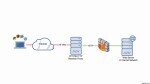
A reverse proxy is a web server that centralizes internal services and provides unified interfaces to the public. Requests from clients are forwarded to a server that can fulfill it before the reverse proxy returns the server's response to the client.
Additional benefits include:
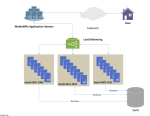
Increased security - Hide information about backend servers, blacklist IPs, limit number of connections per client Increased scalability and flexibility - Clients only see the reverse proxy's IP, allowing you to scale servers or change their configuration SSL termination - Decrypt incoming requests and encrypt server responses so backend servers do not have to perform these potentially expensive operations Removes the need to install X.509 certificates on each server Compression - Compress server responses Caching - Return the response for cached requests Static content - Serve static content directly HTML/CSS/JS Photos Videos Etc Load balancer vs reverse proxy Deploying a load balancer is useful when you have multiple servers. Often, load balancers route traffic to a set of servers serving the same function. Reverse proxies can be useful even with just one web server or application server, opening up the benefits described in the previous section. Solutions such as NGINX and HAProxy can support both layer 7 reverse proxying and load balancing. Disadvantage(s): reverse proxy Introducing a reverse proxy results in increased complexity. A single reverse proxy is a single point of failure, configuring multiple reverse proxies (ie a failover) further increases complexity.