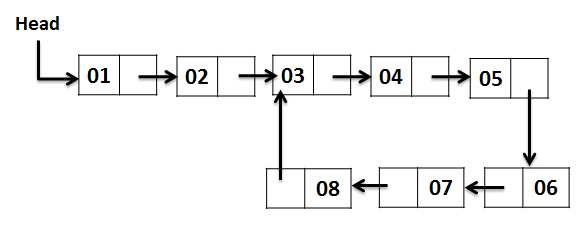
So the question given is to check if the Given Linked list is having a cycle or Not?
We will be using Floyd Cycle to find the solution of the given problem.
It uses 2 pointers moving at different speeds to walking the linked list. Once they enter the loop they are expected to meet, which denotes that there is a loop. This works because the only way a faster moving pointer would point to the same location as a slower moving pointer is if somehow the entire list or a part of it is circular.
Java Solution for the following problem is given below:
package askgif.linkedlist;

class ListNode{
 public int data;
 public ListNode next;
};

public class CircularNodeExist {

	public static void main(String[] args) {

 ListNode node1 = new ListNode();
 ListNode node2 = new ListNode();
 ListNode node3 = new ListNode();
 ListNode node4 = new ListNode();
 ListNode node5 = new ListNode();
 ListNode node6 = new ListNode();
 node1.data = 1;
 node2.data = 2;
 node3.data = 3;
 node4.data = 4;
 node5.data = 5;
 node6.data = 6;
 node1.next = node2;
 node2.next = node3;
 node3.next = node4;
 node4.next = node5;
 node5.next = node6;
 node6.next = node3;

		System.out.println(IsLoopExist(node1));


	}

	private static Boolean IsLoopExist(ListNode ll) {

		ListNode slowPtr = ll;
		ListNode fastPtr = ll;

		while(true){
			if(fastPtr == null || fastPtr.next == null)
				return false;
 slowPtr = slowPtr.next;
 fastPtr = fastPtr.next.next;
 if(slowPtr == fastPtr)
 	return true;

 }
	}

}
output:

true
The time complexity of the above solution is O(n) as we are traversing through the entire linked list once.
Space Complexity: O(1)