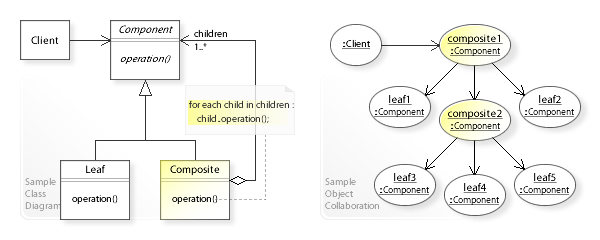
In software engineering, the composite pattern is a partitioning design pattern. The composite pattern describes a group of objects that are treated the same way as a single instance of the same type of object. The intent of a composite is to "compose" objects into tree structures to represent part-whole hierarchies. Implementing the composite pattern lets clients treat individual objects and compositions uniformly.
The Composite design pattern is one of the twenty-three well-known GoF design patterns that describe how to solve recurring design problems to design flexible and reusable object-oriented software, that is, objects that are easier to implement, change, test, and reuse.
What problems can the Composite design pattern solve?
A part-whole hierarchy should be represented so that clients can treat part and whole objects uniformly.
A part-whole hierarchy should be represented as a tree structure.
When defining (1) Part objects and (2) Whole objects that act as containers for Part objects, clients must treat them separately, which complicates client code.
What solution does the Composite design pattern describe?
Define a unified Component interface for both part (Leaf) objects and whole (Composite) objects.
Individual Leaf objects implement the Component interface directly, and Composite objects forward request to their child components.
This enables clients to work through the Component interface to treat Leaf and Composite objects uniformly: Leaf objects perform a request directly, and Composite objects forward the request to their child components recursively downwards the tree structure. This makes client classes easier to implement, change, test, and reuse.
source: wiki