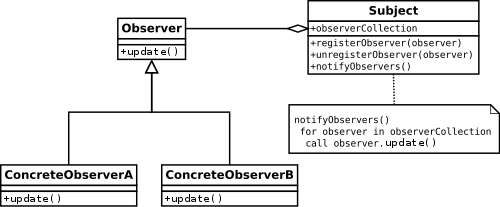
The observer pattern is a software design pattern in which an object, called the subject, maintains a list of its dependents, called observers, and notifies them automatically of any state changes, usually by calling one of their methods.
It is mainly used to implement distributed event handling systems, in "event-driven" software. Most modern languages such as C# have built in "event" constructs which implement the observer pattern components, for easy programming and shortcode.
The observer pattern is also a key part in the familiar model–view–controller (MVC) architectural pattern. The observer pattern is implemented in numerous programming libraries and systems, including almost all GUI toolkits.
The Observer design pattern is one of the twenty-three well-known "Gang of Four" design patterns that describe how to solve recurring design problems to design flexible and reusable object-oriented software, that is, objects that are easier to implement, change, test, and reuse.